Two identical-looking guitars can produce completely different sounds when played. Because there are many factors one should be aware of while purchasing a new guitar, or even when upgrading to a new one. The guitars may vary based on their material, string types, price, and many other factors. Thus, knowing the basics will make your decision better and more informed.
In this guide, we shall explain the major acoustic guitar types, their common body shapes and sizes, acoustic guitar price range, and some of the facts that really do matter while choosing an instrument.
What Are Acoustic Guitars?
Acoustic guitars are string-based instruments that produce sound naturally through the vibration of the strings and resonance of the guitar body. They do not require an amplifier to make the sound audible.
Many modern guitars have six strings and are generally made of steel. Although the classical guitars use nylon strings. Both of them have different constructions and playability.
Acoustic guitars are versatile and can be used for; you can use them to learn chords, songwriting, fingerstyle strumming, giving live performances, or simply to play your favorite song at home as a hobby.
These guitars are a practical starting point for any beginner to develop the basic skills without needing any additional accessories.
Understanding Acoustic Guitar Types
One of the things to understand before purchasing an acoustic guitar is that it comes in several designs. They mainly differ in their body construction, shape, and use case. Let us understand the types of acoustic guitars below:
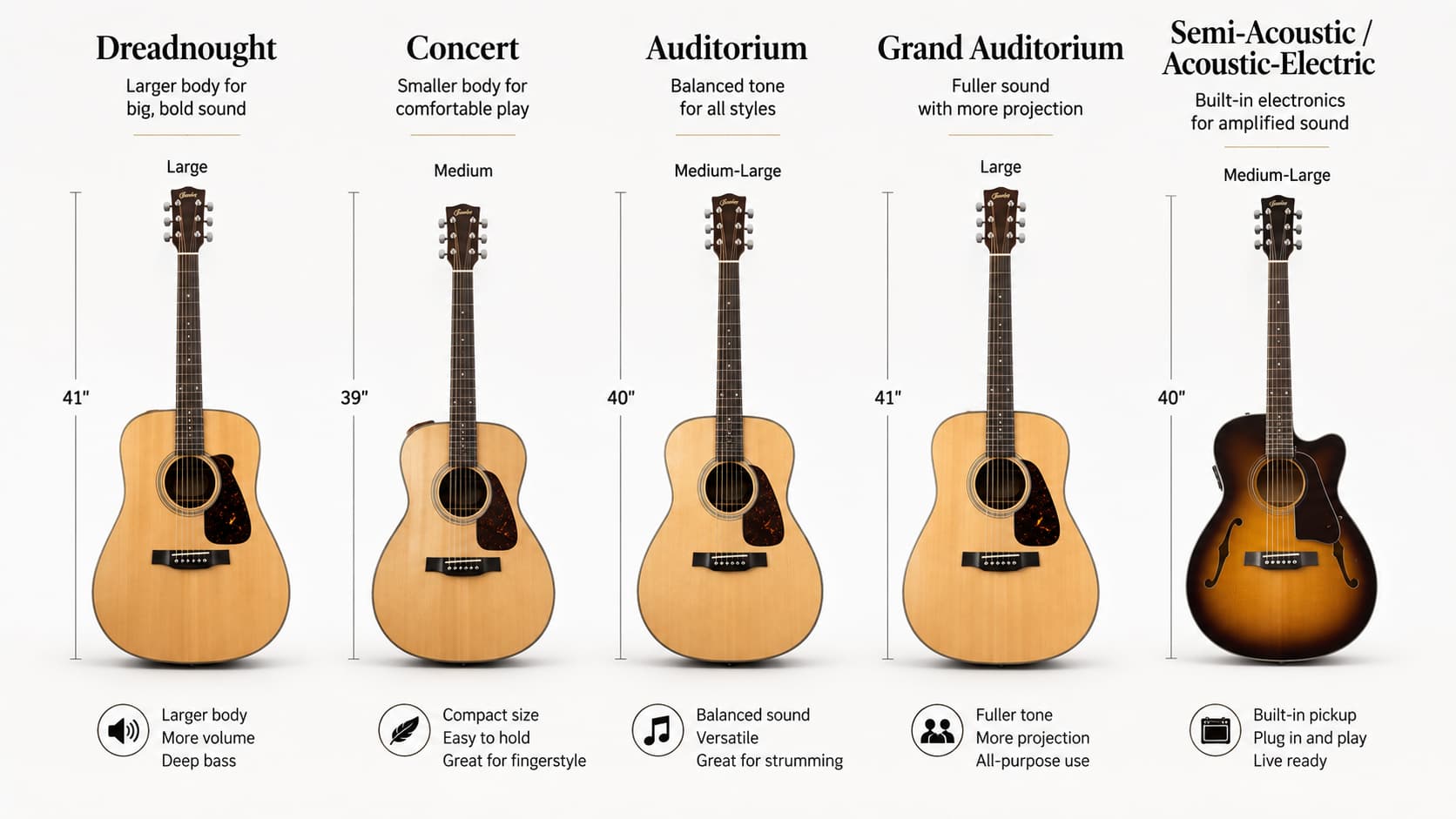
Dreadnought Acoustic Guitar
The dreadnought acoustic guitar is one of the most easily identifiable guitars due to its body shape. It has a large body and a wide waist.
Dreadnought guitars are loved by those who want a powerful, full-bodied sound. Their larger body produces high bass volume and is best suited for rhythm playing and live performances.
However, such a large size may not be comfortable for all players, especially the young ones with a small body frame.
Concert Acoustic Guitar
Concert guitars are generally small compared to dreadnoughts. Their compact and balanced shape makes them comfortable to hold and play with, with a clear, strong grip and balanced sound.
It can be a good option for beginners who have difficulty holding large guitars. It is the best option for fingerstyle players and casual strummers.
Auditorium Acoustic Guitar
An auditorium acoustic guitar offers a middle ground between the small concert guitar and the large dreadnought guitar. Its body is designed to provide a combination of comfort, projection, high bass, and great tonal detailing.
For those who can do both strumming and fingerstyle techniques, this one is perfect for them.
Grand Auditorium Guitar
A grand auditorium guitar is slightly larger and is broader around the waist than the traditional auditorium designs. It is known for its versatility and offers a balanced response across various frequencies.
For any intermediate or experienced player, this type of body can be attractive because it performs well across multiple playing techniques, and you have more room to try new sound combinations.
Semi-Acoustic Guitar
A semi-acoustic guitar is also known as an acoustic-electric guitar because it has the characteristics of acoustic instruments and built-in electronics.
It can be played without an amplifier, but it does have a pickup and preamp, which allow you to connect an amplifier if you need. You can also add a recording setup with this guitar.
This feature makes a semi-acoustic guitar more useful for players who perform live.
Acoustic Guitar Body Shapes and Sizes
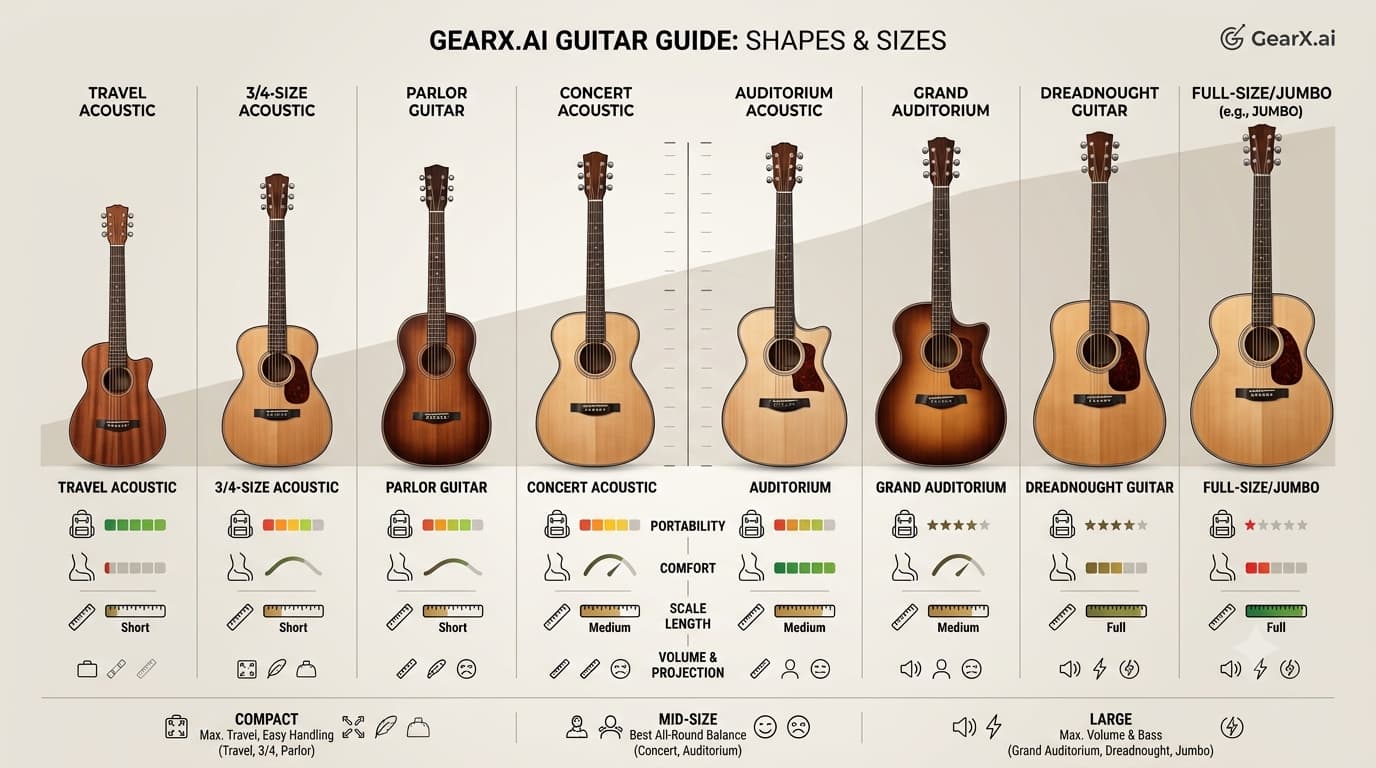
The body shape of the guitar has more impact than its appearance. It influences several factors, such as projection, bass response, tone, and playing comfort, Bass response, and how it responds to your playing, and most importantly, comfort while playing.
Large acoustic guitar body shapes produce great sound and also strong low-end frequencies. On the other hand, small bodies offer great comfort and a focused and balanced tone.
Therefore, physical comfort should also be an important factor when buying a guitar.
Common Acoustic Guitar Sizes
Full-size guitars:
Full-size guitars are suitable for many adults and are available across a wide range of prices.
3/4-size guitars:
They are small and easy to handle, making them suitable for young children, and also for some adults who like compact instruments
Travel guitars:
They are especially designed for portability and practice on the go. They have a strong build compared to others.
Parlor guitars:
These are compact in nature and have a unique vintage-inspired character.
If you are not sure which is best for you, try holding them before buying and see which one feels more comfortable and easy to practice and play.
Acoustic Guitar Price: What Should You Expect?
The acoustic guitar price can vary based on build materials, craftsmanship, brand, hardware, electronics, warranty, and other factors.
As a broad guide in the Indian market, you can generally expect the following at each price range:
|
Price Range |
What You Can Generally Expect |
|
₹3,000–₹7,000 |
Basic starter models suitable for practice |
|
₹7,000–₹15,000 |
Good beginner-friendly options with improved construction and sound |
|
₹15,000–₹30,000 |
Quality instruments for serious learners and intermediate players |
|
₹30,000–₹60,000+ |
Higher-quality guitars for advanced and professional musicians |
|
₹60,000+ |
Premium instruments with superior materials and craftsmanship |
This price range is approximate and may vary based on many factors. Your location, brand, discounts, etc will give you the exact pricing.
Acoustic Guitar for Beginners: What Should You Look For?
For a beginner, the best beginner guitar is not necessarily the one with the longest list of features. But the one that offers great playability. For instance, check for the following:
- Comfortable neck width
- Good string height
- Smooth fret edges
- Stable tuning
- A good body-to-guitar ratio
- Easy to strum strings
How to Choose an Acoustic Guitar
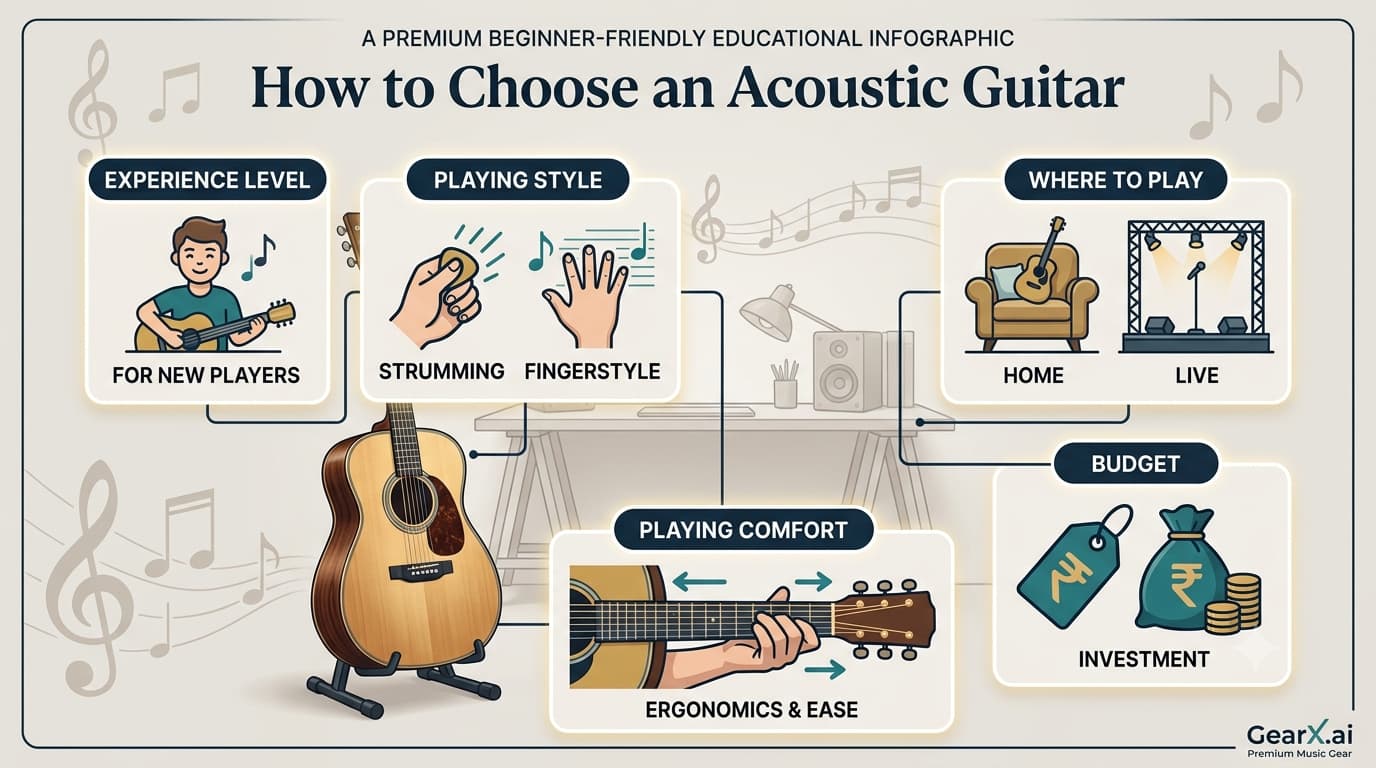
Choosing an acoustic guitar can become very easy if you ask yourself these five questions:
1. What is your experience level?
A beginner needs easy playability. An intermediate player may need improved tonal details, while a professional player may have specific preferences like body shape, tonewood, electronics, and others.
2. What style do you play?
Strumming-heavy players may like a dreadnought, while fingerstyle musicians may prefer smaller or balanced guitar body shapes.
3. Where will you play?
Players can get any acoustic guitar for home practice. For performances, an acoustic electric guitar may be more practical.
4. What is your budget?
Make sure you have a realistic budget for a guitar, which also includes a tuner, a gig bag or case, picks, spare strings, and a strap.
5. How does it feel?
The most important question you must ask yourself is how it feels. Hold the guitar, play some chords, move along the fretboard, listen carefully, and then decide.
Acoustic Guitar for Intermediate and Professional Players
As players play more and gain more experience, the requirements for instruments and their accessories become more specific to their style of playing.
Intermediate: An acoustic guitar for intermediate players offers better tonewoods, hardware, construction, and tonal responsiveness. At this stage, players notice differences in projection, sustain, tonal balance, and neck profile.
Professional: For professional players, factors such as premium tonewoods, solid-wood construction, electronics, consistency, and craftsmanship become more important,
The right acoustic guitar price depends on the player's experience, needs, and budget. A casual player can go with an affordable guitar, while a professional player will benefit from an expensive guitar.
Final Thoughts
Acoustic guitars come in various shapes and sizes, so pick one that fits your needs. Make sure your intended use is clear and set a realistic budget, focusing heavily on comfort and playability.
If you are a beginner, check out a decent acoustic guitar. For performance, choose a grand auditorium guitar and an acoustic-electric guitar for live performances.
Avoid buying a guitar based on its attractive looks or because someone calls it “the best”. You should get a guitar that feels natural to your hands and has an inspiring sound.