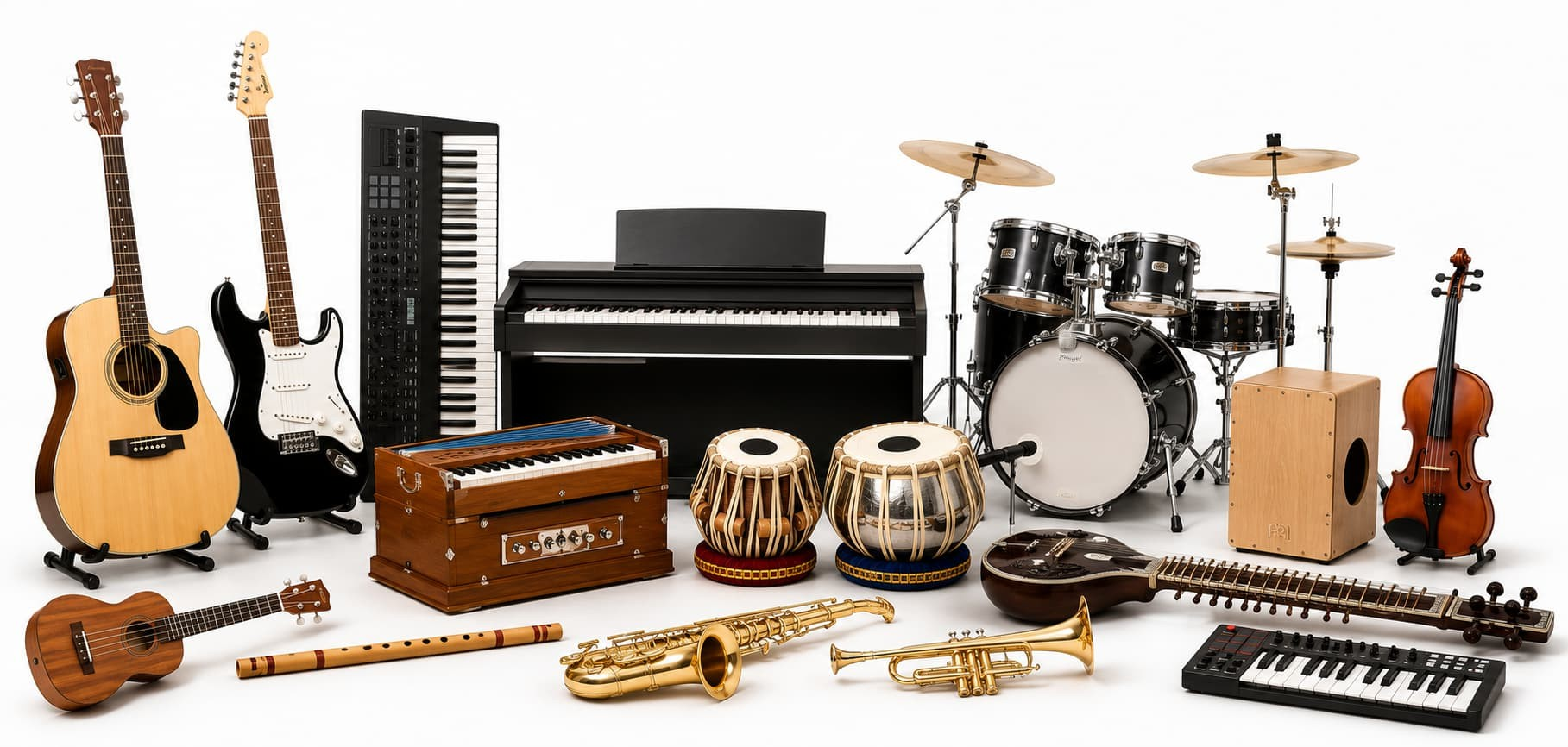
Your love for music will encourage you to play instruments as you explore the world of music. Each instrument has its own special sound, whether it is the guitar in your favourite song or the tabla in a classical performance. Knowing the different types of instruments of music helps you learn what really drives you.
Each instrument has its means of expression, from string and percussion instruments to keyboard, wind and modern electronic instruments.
Here we will guide you to understand the different types of musical instruments, how they are classified, and the instruments commonly used in different genres of music.
What Are the Different Types of Instruments of Music?
The way a musical instrument makes sound is generally the basis for its classification. The sound can be produced by vibrating strings, air, percussion or electronics.
The main types of musical instruments are the following:
- String instruments
- Percussion instruments
- Keyboard instruments
- Woodwind instruments
- Brass instruments
- Electronic instruments
String Instruments
String instruments make sound by setting their strings into vibration. They can be bowed, plucked or struck depending on the instrument.
Popular examples include:
- Acoustic guitar
- Electric guitar
- Bass guitar
- Violin
- Viola
- Cello
- Ukulele
- Mandolin
- Sitar
- Sarod
- Veena
There is a plethora of excellent stringed instruments for beginners. Acoustic guitar is really a good option for beginners due to its rich natural sound. It doesn’t need amplification and is available in India in a wide range of sizes and price points.
Another beginner-friendly instrument is the ukulele due to its small size and limited strings.
Before purchasing a guitar, consider body size, neck comfort, string action, build quality, acoustic or electric design, and required accessories. For a violin or other bowed instrument, the quality of the bow, strings and setup also plays an important role.
Best for: Singing, songwriting, classical music, folk music, rock, pop, and performances.
Percussion Instruments
Percussion instruments are ones that make sound when they are hit, shaken or scraped. They are the rhythmic basis of many styles of music.
Examples include:
- Drum kit
- Tabla
- Cajon
- Dhol
- Bongos
- Congas
- Tambourine
- Kanjira
- Xylophone
Percussion is ideal for those new to music who are naturally rhythmic and physical. The cajon might be a good choice for those that want to play casually, acoustically or in small jam sessions. Tabla is a good choice if you are interested in Indian classical music and rhythm.
Learn about the space you have available for practice when choosing a drum kit, as acoustic drum kits take up a lot of space and can be very loud.
Before making a purchase, consider size, playing surface, material, sound quality, portability, practice space and any necessary accessories.
Best for: Rhythm lovers, live performance, Indian classical music, folk music, rock, and band-based music.
Keyboard Instruments
The keyboard is one of the most versatile instruments for beginners. It helps beginners understand melody, chords, harmony and music theory.
Common keyboard instruments include:
- Keyboard
- Digital piano
- Acoustic piano
- MIDI keyboard
- Synthesizer
- Harmonium
Although these instruments may look similar, they all play different roles.
Keyboard: A keyboard is a good choice for starters as it is portable and has various tones and rhythms. Good for beginners, pop music, and casual learning.
Digital Piano: The playability of a digital piano is closer to an actual piano and is convenient for people who want to learn piano without buying an acoustic piano. It is best for piano students, classical music, and home practice.
MIDI Keyboard: MIDI keyboards usually don’t produce sounds on their own. Instead, it is plugged into a computer or tablet, which makes it ideal for music producers, composers, and home studio enthusiasts.
Synthesiser: A synthesiser helps musicians produce and sculpt sounds. It is used for electronic music, pop music, soundtrack music and sound design.
Harmonium: Harmonium is used in Indian classical, devotional and folk music.
When you are choosing a keyboard instrument, think about whether you want to play the piano, use lots of sounds, make music or make sounds.
Woodwind Instruments
Woodwinds are instruments that produce sound by air movement and vibration. Some are blown across a mouthpiece, creating a sound, others are blown through or across a hole to create a sound.
Common examples include:
- Flute
- Bansuri
- Harmonica
- Clarinet
- Saxophone
- Oboe
Bansuri is a favourite among beginners who are interested in Indian classical music. The harmonica is small and easy to take along when you travel. But saxophone and clarinet players need more control of their breathing techniques.
Before buying a woodwind instrument, consider the material, tuning, mouthpiece quality, size, ease of cleaning, protection, and other accessories.
Best for: Melody lovers, classical musicians, jazz players, folk musicians, and performers who enjoy expressive, breath-controlled sounds.
Brass Instruments
A brass instrument produces sound when the player vibrates his or her lips against the mouthpiece.
Common brass instruments include:
- Trumpet
- Trombone
- French horn
- Tuba
- Euphonium
These instruments are most often used in orchestras, marching bands, jazz groups and concert bands. Beginners need to practise breathing, lip control and embouchure.
The trumpet, for example, is popular in jazz, pop, and marching bands. The trombone has a distinctive sliding mechanism, while larger instruments such as the tuba create deep bass sounds.
Best for: Jazz, orchestras, marching bands, and ensemble performance.
Electronic Musical Instruments
Modern music has expanded the concept of musical instruments. Electronic instruments offer musicians the possibility to create, change, capture and perform sounds in new ways.
Examples include:
- Synthesizers
- MIDI keyboards
- Electronic drum kits
- Drum machines
- Samplers
- Digital controllers
For beginners who are interested in music production, electronic instruments can be an excellent starting point.
A simple setup could be:
MIDI keyboard - Computer - DAW software - Headphones or studio monitors
A synthesiser can make sounds by itself, and gives you more control over the sound design.
Electronic instruments are especially useful for music production, electronic music, film scoring, sound design, home recording and live performance.
If you are setting up a home studio you may also require some additional equipment such as an audio interface, headphones, studio monitors and some suitable cables.
Different Instruments of Music Based on Musical Genres
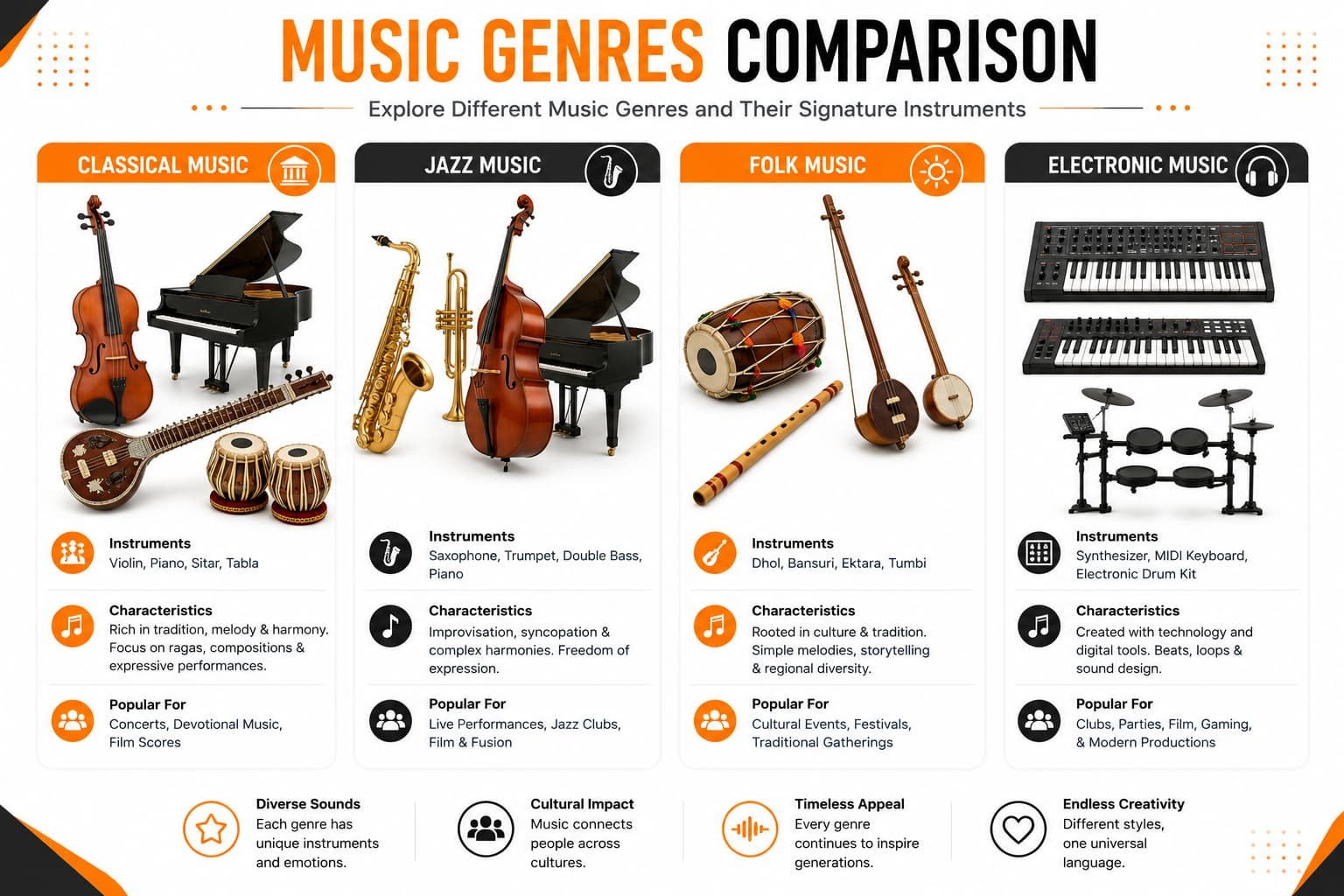
The instrument you choose can also depend on the type of music you enjoy.
Instruments of Classical Music
Classical music includes both Western classical and Indian classical traditions. Western classical instruments include:
- Piano
- Violin
- Viola
- Cello
- Double bass
- Flute
- Clarinet
- Oboe
- French horn
Indian classical instruments include:
- Sitar
- Tabla
- Sarod
- Bansuri
- Sarangi
- Santoor
- Veena
- Harmonium
Your choice may depend on whether you prefer melody, rhythm, or accompaniment.
Melody: Bansuri, Sitar, Sarod
Rhythm: Tabla, Pakhawaj
Accompaniment: Harmonium
Plucked string tradition: Veena, Sitar
Instruments of Jazz Music
Jazz is known for improvisation, rhythm, and musical interaction between performers.
Popular instruments include:
- Saxophone
- Trumpet
- Trombone
- Piano
- Double bass
- Drums
- Electric guitar
The trumpet and saxophone are used to play jazz tunes and improvisation. Piano and guitar give harmonic support while bass and drums create the rhythmic foundation.
If you decide to study jazz, it is especially good to choose an instrument that allows for improvisation.
Instruments of Folk Music
Folk music is said to reflect the culture, traditions, and history of a region. Thus, the instruments of folk music are very diverse in India and in the world.
Indian folk instruments include:
- Dhol
- Ektara
- Dotara
- Bansuri
- Sarangi
- Algoza
- Tumbi
Folk instruments can be a great choice for beginners who want to connect with regional music and traditional styles of performance.
Popular Musical Instruments in India for Beginners
The right choice varies based on your music preferences, interests, budget, and goals.
|
Instrument
|
Best For
|
Beginner Friendly
|
Portability
|
|
Guitar
|
Singing, pop and songwriting
|
Yes
|
High
|
|
Keyboard
|
Melody, chords and music theory
|
Yes
|
Medium
|
|
Ukulele
|
Casual playing and pop music
|
Yes
|
Very High
|
|
Tabla
|
Indian classical rhythm
|
Moderate
|
Medium
|
|
Bansuri
|
Indian classical melody
|
Moderate
|
High
|
|
Cajon
|
Rhythm and acoustic performance
|
Yes
|
High
|
|
Harmonica
|
Folk, blues and casual playing
|
Yes
|
Very High
|
|
MIDI
Keyboard
|
Music production
|
Yes
|
High
|
This comparison can help you narrow down your options before you start shopping.
Which Musical Instrument Should a Beginner Go For?
The best instrument for your musical tastes is usually the one you are genuinely interested in practising and playing.
If You Want to Sing While Playing
Consider:
- Acoustic guitar
- Keyboard
- Ukulele
These instruments are popular choices for singers and songwriters.
If You Enjoy Rhythm
Consider:
- Tabla
- Cajon
- Drum kit
- Electronic drums
If You Enjoy Melody
Consider:
- Flute
- Bansuri
- Violin
- Keyboard
If You Want to Produce Music
Consider:
- MIDI keyboard
- Synthesizer
- Electronic drum kit
You may also need additional equipment such as an audio interface, headphones, and studio monitors.
If You Love Indian Classical Music
Consider:
- Tabla
- Sitar
- Bansuri
- Harmonium
- Sarod
- Veena
If You Are Interested in Jazz
Consider:
- Saxophone
- Trumpet
- Piano
- Double bass
- Jazz guitar
The thing is to choose an instrument you actually want to practise. Your interest will play a bigger role in your progress than just picking the instrument that is considered the “easiest.”
What Should Beginners Look For Before Buying a Musical Instrument?
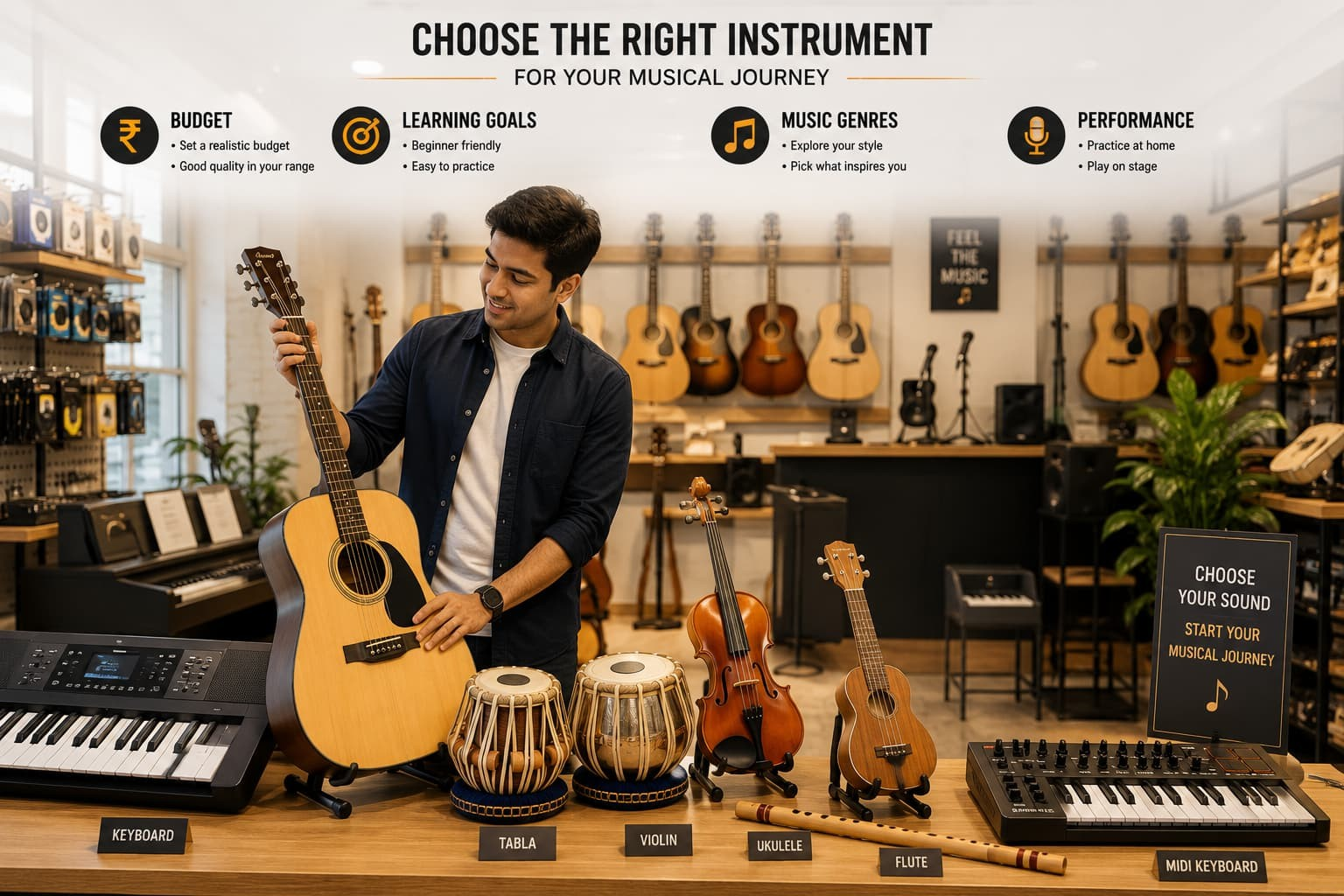
Once you have learned about all instruments of music, it is time to think about the purchase itself.
Set a Realistic Budget
Your budget should include more than just the instrument. Depending on what you choose, you may also need a carrying case, stand, tuner, picks, strings, cables, amplifier, sustain pedal, cleaning kit, or headphones.
For example, buying an electric guitar also means considering an amplifier and cable. A keyboard player may need a stand and sustain pedal.
Consider the Size and Portability
Fix the place for where and how you will use the instrument. If you have a smaller home or do a lot of travelling, you might prefer smaller instruments like a ukulele, harmonica or portable keyboard.
If you have enough space and want to practise at home, a digital piano or full-size drum setup may be more suitable.
Understand the Learning Curve
An instrument can be easy to start but still take years to master. Consider:
- How much time you can practice
- Whether you plan to take lessons
- How comfortable the instrument feels
- Whether you want to play casually or professionally
Choosing an instrument based only on the idea that it is “easy” may not always lead to long-term interest.
Check the Accessories You Will Need
Accessories are an important part of your buying decision.
For guitars: Tuner, picks, strap, gig bag, and extra strings.
For keyboards: Stand, sustain pedal, headphones, and bench.
For drums: Drumsticks, drum throne, practice pad, and headphones for electronic drums.
For wind instruments: Cleaning kit, case, and reeds, where applicable.
Buying the right accessories can improve both the playing experience and the lifespan of your instrument.
Choose Quality Over the Lowest Price
A cheap instrument may seem appealing. But it may lack comfort and can make learning difficult.
Instead, look for good construction, playability, features, tuning, trusted brands and warranties or after-sales support where applicable.
A good beginner instrument will help you enjoy practising more and keep you motivated.
New vs Used Musical Instruments: Which Should Beginners Buy?
Both new and used instruments have their own pros and cons.
New Instruments
A new instrument generally offers:
- Better condition
- Warranty options
- Predictable quality
- Access to the latest features
This option is a comfortable choice for beginners who are not confident about inspecting a used one.
Used Instruments
Used instruments may offer:
- Lower prices
- Access to higher-level models
- Good value for money
However, carefully check physical damage, tuning stability, electronics, moving parts, and wear and tear.
If you are buying your first instrument, a reliable new instrument can often provide a simpler experience.
Conclusion: Choose the Instrument You Will Enjoy Playing
There are a number of different types of musical instruments. Each instrument has its own way of performing and expression.
Maybe you want to learn the guitar so you can sing along with your favourite songs. You choose a keyboard because you want to learn chords and melodies. Or perhaps you are attracted to the tabla, sitar or bansuri because you have an interest in Indian classical music.
The best one is the one that matches your musical interests, learning goals, available space and budget.
Before buying, take time to understand the instrument, compare the features and think about the accessories you may need. Are you looking for a beginner guitar, keyboard, percussion, wind instrument or something for music production? Choosing the right gear from the outset can make your musical journey so much better.
Still confused about which instrument is right for you?
Pick an instrument that you are interested in and that fits your budget. GearX is your one-stop shop online for everything you need to start your musical journey, including guitars and a range of beginner-friendly instruments. Find your favourite instrument and get started today!