Have you ever wondered how the same guitar can sound warm, aggressive, or any other tone? It is because of the small changes you make to those guitars. Now, you might think, what small changes? So, the answer is effects pedals for guitar. Each pedal brings a new tone, from overdrive to distortion to wah, delay, chorus, and reverb. The most interesting part is to know when to use which pedal. Thus, to help you start your journey with a guitar effect pedal, we shall explain the types of guitar effect pedals, their uses, the right guitar pedal signal chain, pedal order, effects loop, and some practical tips for building your pedalboard.
What Are Effects Pedals for Guitar?
Effects pedals for guitar are electronic devices that are used to modify the sound of your guitar signal. They are placed between the guitar and amplifier and are controlled with a footswitch. The footswitch allows you to easily turn it on and off while playing guitar.
A guitar effects pedal can change the characteristics of the tone, such as gain, tone, pitch, volume, timing, or ambience. Based on various pedals, you can make your guitar sound cleaner, heavier, wider, and more spacious, or something completely different.
Popular Guitar Effects Pedal Types and Their Uses
The knowledge of guitar pedal effects will help you decide which one is suitable for you.
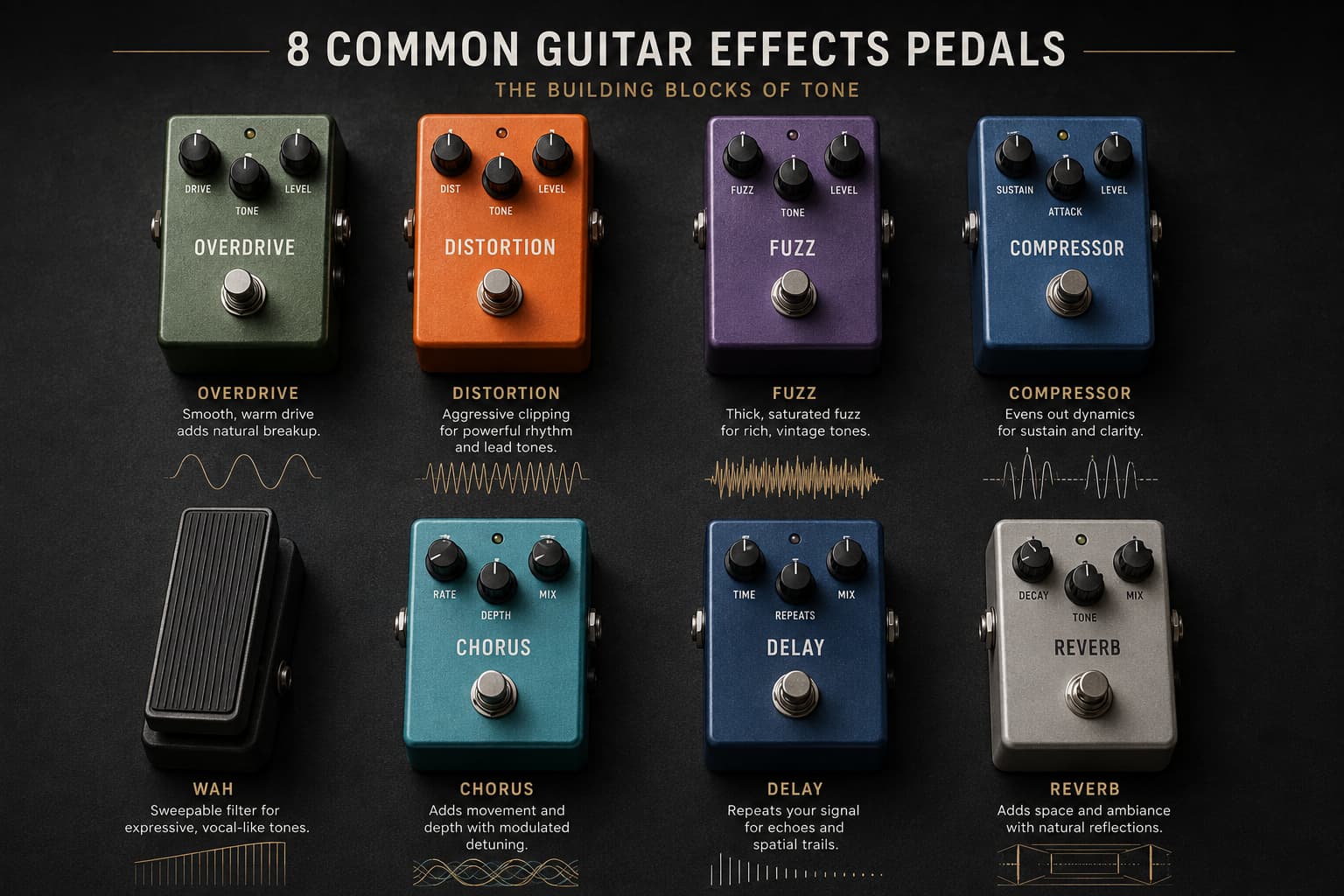
1. Overdrive Pedals
Overdrive pedals create a warm, slightly compressed, and driven guitar tone. Generally used for blues, rock, and classic rock styles of music, wherein players are looking to break the sound naturally.
2. Distortion Pedals
Distortion pedals generally offer a more aggressive sound than overdrive. It is famous for rock, hard rock, metal, punk, and similar heavy sounds.
3. Fuzz Pedals
Fuzz pedals are well-known for their thicker sound, but they can also produce a softer, compressed, and clipped tone. They are very popular in psychedelic rock, classic rock, alternative music, and experimental guitar styles.
4. Compressor Pedals
A compressor pedal helps control the dynamic range of the guitar signal. It allows the quiet notes to be noticeable and makes the whole sound like the low and peak notes are controlled.
5. Wah Pedals
Wah pedals for guitar create a vocal tone that emphasises various frequency ranges with the movement of your foot on the pedal. It can be used when you are a solo player; it can generate either subtle or dramatic sound depending on your usage.
6. Chorus Pedals
It creates the impression that multiple guitars are playing together. They slightly vary in their pitch and timing and duplicate the signal from the main guitar. It produces a wide sound, suitable for open-air concerts, etc. Chorus is mainly useful for arpeggios, ambient textures, pop, rock, and any retro-inspired music.
7. Delay Pedals
As the name suggests, it delays the guitar signal at the selected interval of time. Based on the settings, it can create a slapback effect, rhythmic repetitions, long echoes, etc. Delay pedals add depth and significant rhythmic effects to your tone.
8. Reverb Pedals
Reverb pedals for guitar simulate the natural reflection of the sound from closed areas; it can be a room, a hall, or any large space. It makes the guitar sound more spacious and natural.
Understanding the Guitar Pedal Signal Chain
As we saw that effect pedals are placed between your guitar and amplifier, let us understand how the guitar pedal signal chain works. It means how your sound is travelling from the guitar to the amplifier.
A common starting point is:
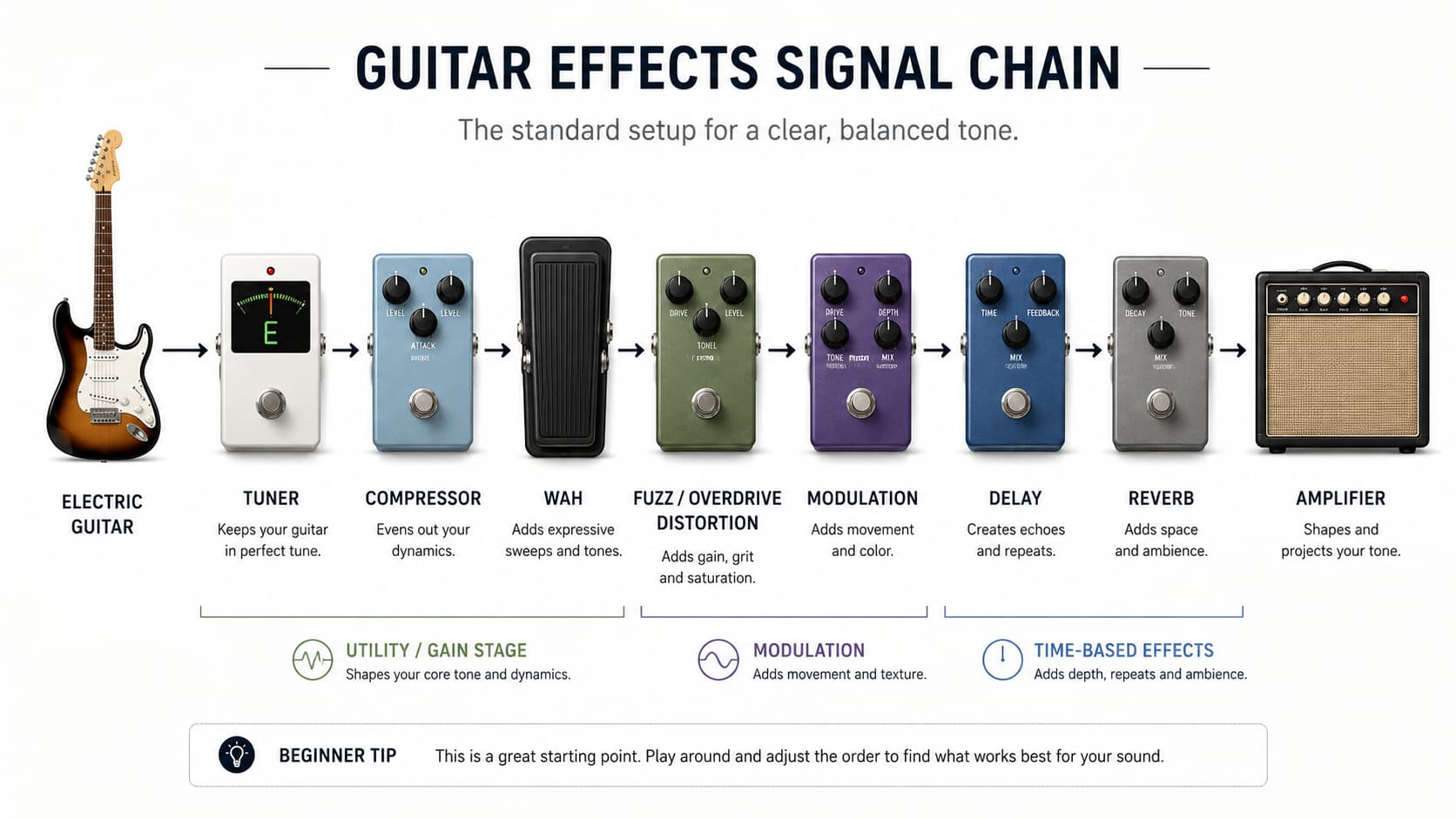
Guitar → Tuner → Compressor → Wah → Fuzz/Overdrive/Distortion → Modulation → Delay → Reverb → Amplifier
This is not the only way; you can adjust the guitar pedal order and can generate more unique sounds that work well with your theme.
Why Does Pedal Order Matter?
Each pedal receives the signal produced by the device before it. Changing any device randomly can alter the final tone. For example, placing delay before distortion can create a heavily repeated and deep sound. But if you keep the delay after distortion, it can generate a clear final output.
The best effect pedal order is ultimately the one that works for your playing style, occasion, and song type.
A Practical Guitar Pedal Order
If you're unsure where to start, try the following arrangement:
1. Tuner → 2. Compressor → 3. Wah → 4. Fuzz → 5. Overdrive → 6. Distortion → 7. Chorus → 8. Delay → 9. Reverb
Here's why this arrangement works well for the beginners:
- Tuner: Receives a clean guitar signal for accurate tuning.
- Compressor: Shapes the dynamics early in the chain.
- Wah: Alters the guitar's frequency response.
- Fuzz: Processes the guitar's raw signal for its characteristic saturated tone.
- Overdrive/Distortion: Adds gain and harmonic saturation.
- Chorus: Adds modulation and width.
- Delay: Creates echoes and repetitions.
- Reverb: Adds ambience and space toward the end.
Let me remind you all again that this order is also not universal; you can always try different pedal sequences and see which one works best for you!
What Is an Effects Loop?
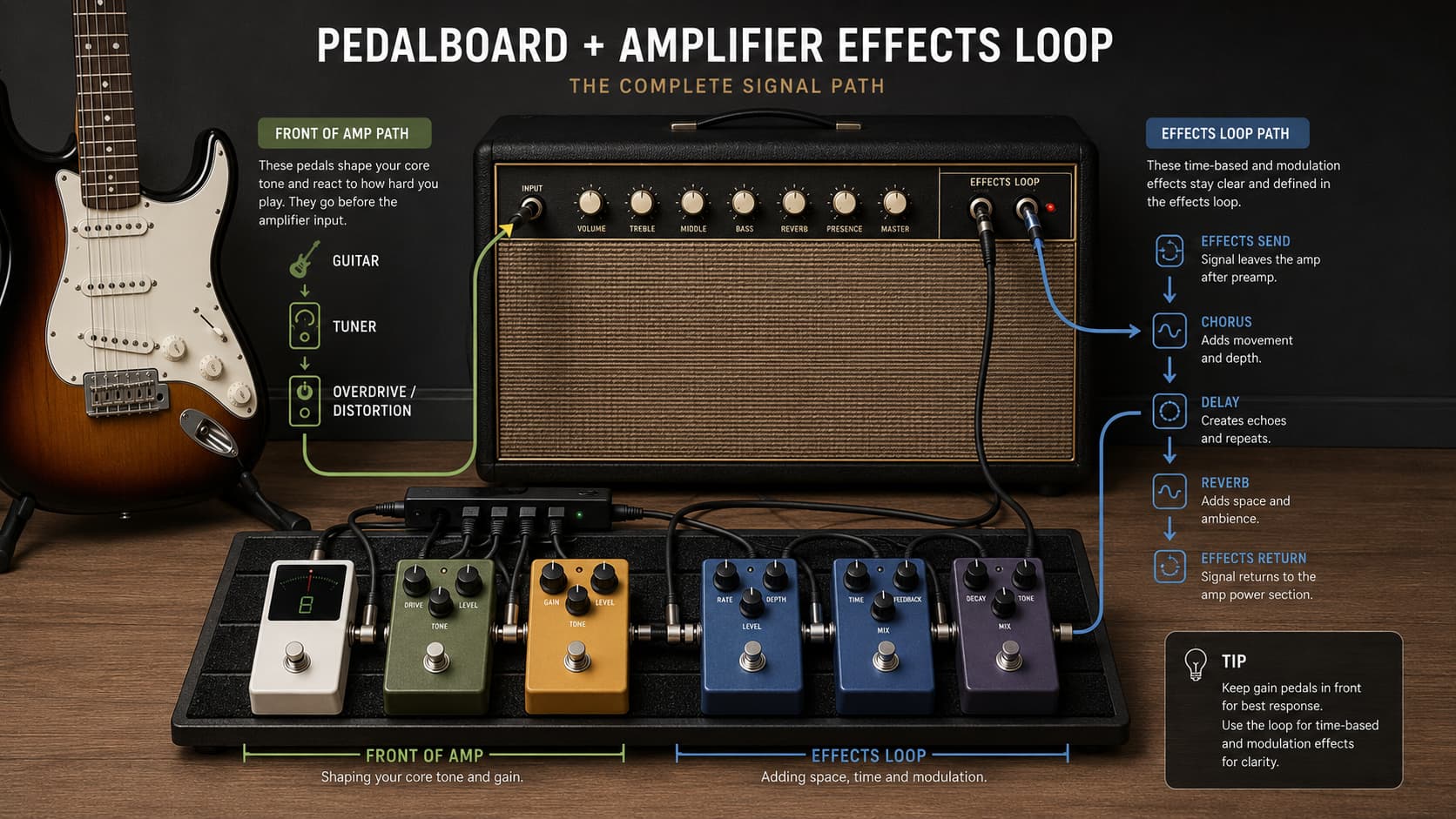
An effects loop is a connection in an amplifier that allows certain pedals to be inserted between the amplifier's preamp and power amp sections. Instead of connecting everything directly between the guitar and amplifier input, you may have a setup such as:
Guitar → Gain Pedals → Amplifier Input
and then:
Amplifier Effects Send → Modulation/Delay/Reverb → Effects Return
An effects pedal loop can be particularly useful when you're using an amplifier's own overdrive or distortion from its preamp.
Which Pedals Go in an Effects Loop?
Time-based effects pedals such as delay, reverb, chorus, etc can go in an effect loop. Gain-based pedals such as overdrive, distortion, and fuzz are generally placed in front of the amplifier. However, there are no absolute rules.
Guitar Pedal Board Setup: How to Get Started
Once you have collected all the pedals, now is the time to set up a guitar pedal board for mounting and connecting your effects in a sequence. It must not focus only on order, but on the practical use too!
1. Start With the Effects You Actually Use
Buy only those pedals that are appropriate for your playing style. Don't go for popularity.
For example, a beginner might start with: Tuner, Overdrive, Distortion or fuzz, Delay, Reverb. Others can be added later as per the need.
2. Think About Power
Pedals run on an electric power source, so check for their battery consumption and required voltage, etc. Using an incompatible power supply can damage the device or may create unnecessary noise.
3. Use Good-Quality Patch Cables
Your pedals need short cables to connect one effect to the next. Reliable patch cables help maintain a stable connection and reduce potential problems on stage or during practice.
4. Leave Enough Space
Keep enough space between each pedal for easy foot access, or else they will lead to mixed signals and create a completely disastrous sound.
5. Label or Plan Your Connections
If you have a large pedal board, keep them labelled for ease of work and also to troubleshoot any problems in the future.
How to Set Up Effects Pedals for Electric Guitar
A simple beginner setup can look like this:
Guitar → Tuner → Overdrive → Delay → Reverb → Amplifier
Start by keeping all the pedals off, set the amplifier first to a clean tone, and then activate the pedals one by one.
Once you know which pedal creates which effect, try making adjustments and changing their sequence to give yourself a surprise.
Effects Pedal Switch: What Does It Do?
The effects pedal switch is the foot-operated control that turns the effect on or off. Based on the pedal design, the switch may operate mechanically or electronically.
Some modern pedals also include additional switches to the pedals to offer features such as preset selection, Tap tempo, Boost, Expression functions, Loop control, Special effect modes, etc. This can also vary based on the manufacturer you are choosing for your effect pedals.
Final Thoughts
Effects pedals for guitar are one of the best ways to explore new sounds and make your guitar playing more expressive, engaging, and fun. From the natural warmth to aggression, from chorus to reverb, all pedals have something to shape your guitar tone.
It is more about choosing the right pedals for your pedalboard. Start the journey with a few essential ones and learn the basics of guitar pedal order. Once you get comfortable, try adding more pedals to increase the range of your tone.