If you've ever been to a live concert, visited a recording studio, or watched YouTube videos about making music, then you’ve probably seen synthesizers in action. At first glance, it can look like a keyboard with some extra buttons, knobs and sliders. But once you hear the enormous range of sounds it can generate, you understand it as much more than simply another keyboard.
Let’s learn exactly What is a synthesizers?. Today, synthesizers are popular with beginners, singers, keyboard players, composers, DJs, worship artists, and music producers. Whether you’re purchasing your first instrument, establishing a home studio, or just looking for some original music, a synthesizers opens up a world of creative possibilities.
In this article you will learn about what is a synthesizers, how do they work, the different sounds they can produce, the types of synthesizers and the features you should look for prior to buying.
What Is a Synthesisers?
Synthesizers — An electronic musical instrument that generates and modifies sounds. A piano will always sound like a piano whereas a synthesizers may produce hundreds of different tones, from authentic instruments to totally creative electronic sounds. It’s not just about playing notes. It’s about shaping your own music with help of existing sounds using a range of settings and effects. That’s the sort of flexibility that has made synths so popular with producers and musicians.
Difference between a keyboard is same as ordering pre-made meal vs cooking dish by yourself and building your own flavours
This is why you often see analogue synths being referred to as sound design instruments. They don’t only play music, they give you the power to create your own sound.
History of synthesizers :
Before the invention of synthesizers, artists played only acoustic instruments such as pianos, guitars, violins and drums. These instruments are evergreen but the composer wanted to play around more with the sounds from their imagination which traditional instruments could not provide.
This led to the introduction of synthesizers, allowing artists to produce futuristic sounds, effects, deep basslines, cinematic pads and electronic textures that have defined modern music. When you listen to a chart-topping song or watch a movie there is a good possibility you are hearing a synthesizers somewhere in the background.
Types of synthesizers
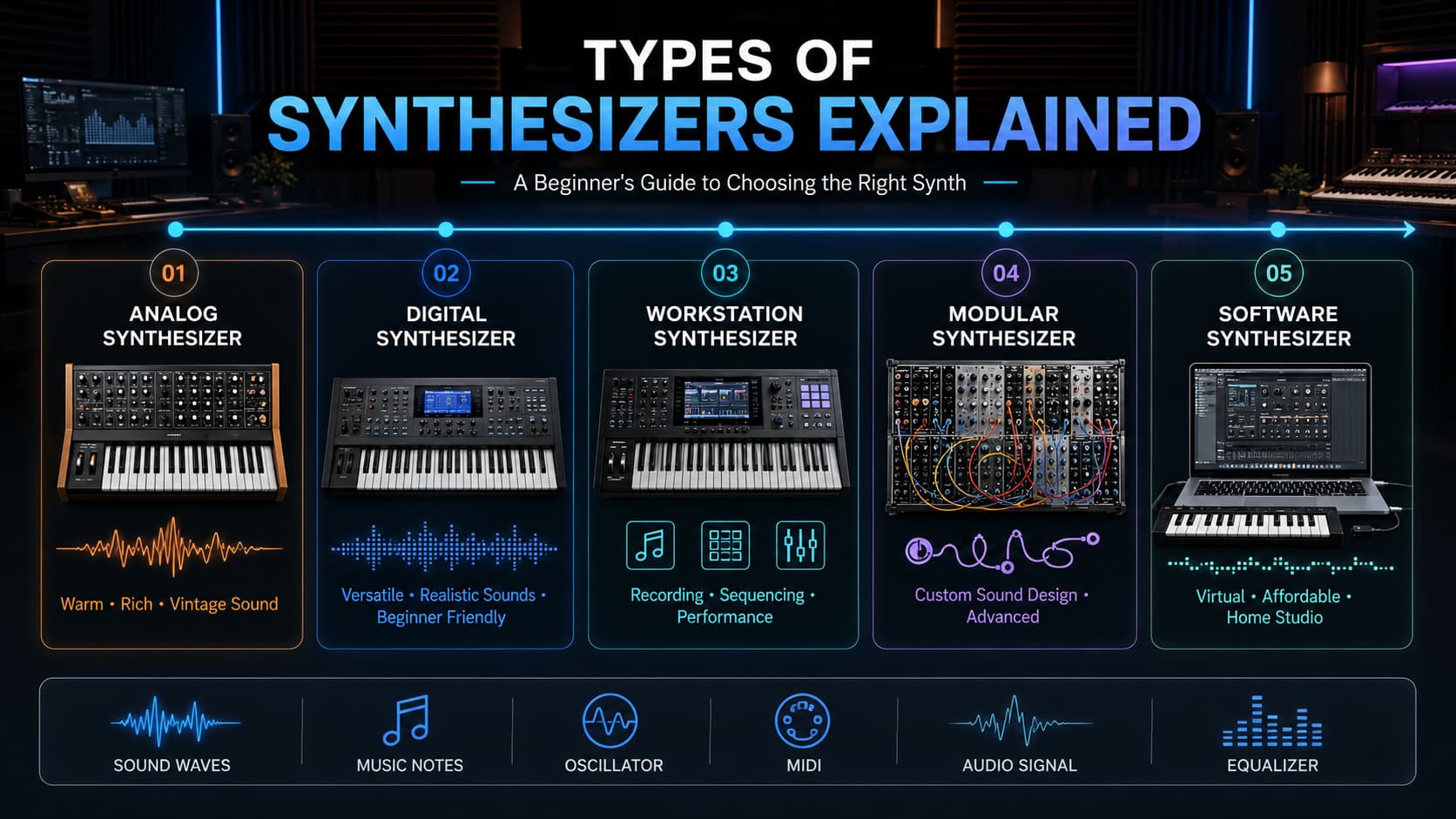
Understanding the types of synthesizers makes choosing one much easier. Each type is designed for different users and musical goals.
Analog synthesizers
Analogue synths are loved for their warm, rich, vintage sound. They make sound with electronic circuits, and the sound quality is often called smooth and organic.
They are often used in retro music, funk, classic rock and techno.
Best for: Vintage sound lovers and experienced musicians.
Workstation synthesizers
The workstation integrates a synthesizers together with functions for recording, sequencing, accompaniment, and performing.
It is a multi-functional music production device wherein one can compose, arrange, and perform music without requiring other devices.
Best for: Professional musicians, composers, and music producers.
Modular synthesizers
Modular synthesizers allow you to connect up different modules to create your own sound system.
They are almost limitless in their possibilities for sound design, but require a lot of technical knowledge and experience.
Best for: Advanced sound designers and synthesizers enthusiasts.
Software synthesizers (Virtual Synths)
No hardware is involved, and the computer or Digital Audio Workstation performs software synthesis. This method of sound generation is widely used in contemporary music production due to its ease and low cost.
Best for: Home studios, producers, composers, and beginners exploring music production.
Keyboard vs synthesizers
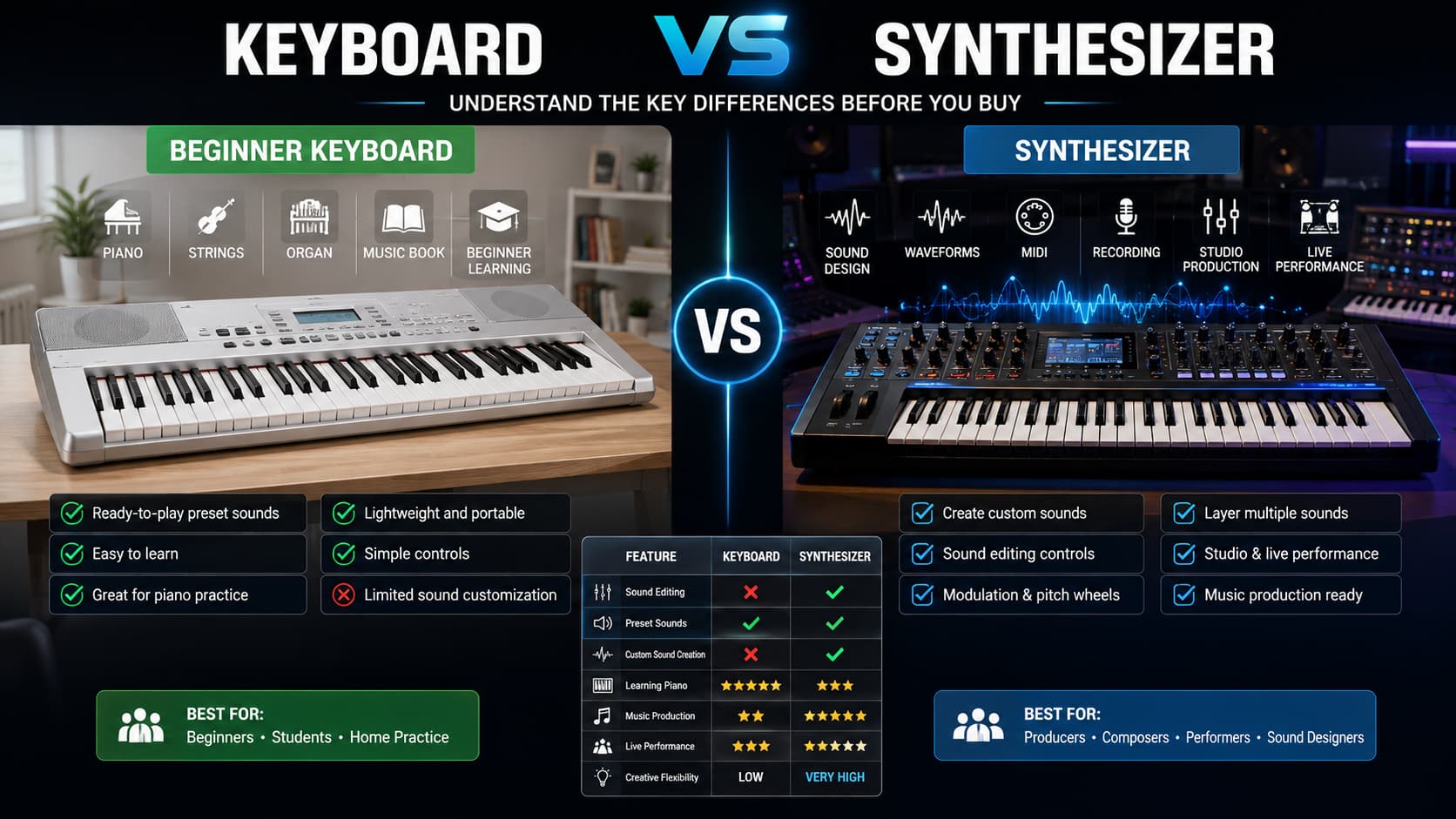
Perhaps one of the most frequent questions asked by beginners is which instrument to use between these - keyboard vs synthesizers. Even though these instruments may seem the same in appearance, they have their own uses.
The keyboard is an instrument which will help to play pre-programmed instrument sounds such as piano, string, organ and so on. It suits beginners well who wish to master music, for students getting ready for an exam, and for people seeking simplicity of playing.
However, the synthesizers offer many more possibilities. Apart from playing sounds, you will be able to edit them. You will change the sound tone, apply special effects, design a completely new sound, layer sounds of several instruments. synthesizers suits much better for those who love creativity.
So, you should choose synthesizers if your purpose is to write songs, perform live, create music and so on. But you don’t need a synthesizers just to learn the piano.
Beginner-friendly synths include:
Digital synthesizers -
Good for beginners as they have many of preset sounds and are usually easier to navigate.
Entry-level synthesizer -
Has simple controls and beginner - friendly attributes.
Workstation Keyboards -
For beginners who want to learn, create, record and experiment with many sounds in one instrument.
Software synthesizers -
A cheap solution for those just getting into music creation and working on a computer.
What Kind of Sounds Can a Synthesizer Produce?
Its amazing range of sounds is one of the biggest reasons musicians buy a synthesizers. Traditional instruments can only produce one type of tone. With a synthesizers you can explore everything from realistic acoustic instruments to futuristic electronic textures, all from a single instrument.
It’s like an entire band all in one keyboard. A synthesizers offers sounds that fit almost any musical style, whether you’re writing a song, producing a film score, performing live or just exploring new ideas.
Here are some of the most popular sounds that you will find in modern synthesizers:
Piano Music
Most synthesizers have good sounds for grand piano, upright piano and electric piano. They are great for practice, songwriting, live performance and for accompanying singers.
Suitable for: Pop, Bollywood, worship, piano performances.
Strings & Orchestra
Need that emotional feel of violins or the grandeur of an orchestra? synthesizers are popular with composers and film musicians because they can generate lush string sections, cellos, brass sections and full orchestral arrangements.
Best for: background music, cinematic music, and orchestral performances.
Pads
Pads are soft, sustained sounds that add atmosphere. They don’t stick out but sit behind the melody making your music sound fuller and more emotional.
Think of the lush background in worship songs, ambient music, and movie soundtracks; that’s often created with pads.
Best for: ambient music, worship, cinematic compositions, and slow ballads.
Sounds of Bass
Bass makes the foundation of a song. Synthesizers can create everything from smooth bass guitar sounds to the big electronic bass used in EDM and hip-hop.
If you make dance music, or even just want to add some depth to your composition, you need bass sounds.
Best for: EDM, pop, rock, funk and Bollywood music.
Lead Sounds
Lead sounds are designed to catch your attention. They are often used for melodies, solos and hooks that stand out in a song.
If you’ve heard an upbeat electronic melody or a catchy synth solo you’ve probably heard a lead sound.
Best for: Pop, EDM, rock and live performance.
Plucking
Plucks are short, sharp, punchy sounds that instantly add rhythm and energy to a trac. You’ll hear them a lot in tropical house, electronica and modern pop productions.
Best for: Rhythmic patterns
Brass & Woodwinds
Modern synthesizers can copy instruments like trumpets, saxophones, flutes, clarinets and horns. They may not be a perfect substitute for real instruments, but they are great for live performance, songwriting, and music production.
Best for: jazz and blues
Sound FX
One great thing about a synthesizers is that it can produce sounds that do not occur in nature.
Musicians can play around with synths to their heart’s content - from space-like effects and sweeping risers to futuristic textures and cinematic impacts.
This is one of the main reasons why producers and composers prefer synthesizers over traditional keyboards.
Best for: Electronic Music and film scoring
What Features Should Beginners Look For?
When exploring different models, you’ll notice long lists of specifications. While every feature has its purpose, you don’t need to understand every technical detail before making your purchase.
Instead, focus on the features that genuinely improve your playing experience and support your musical goals. This synth buying guide highlights the most important ones.
Large Sound Library:
A synthesizers with a large library of sounds built in provides you greater freedom to be creative. Instead of being restricted to a handful of instruments, you may switch rapidly between piano, strings, synth leads, bass, drums, orchestral sounds and much more.
For beginners, this scenario means that you will have lots of room to explore different genres without having to buy more equipment.
Touch-Sensitive Keys:
Touch-sensitive keys respond to the pressure of a finger on them. Gently press and you will hear a softer sound. The louder and more expressive the sound becomes when you press harder. This feature makes your play feel natural and develops good technique from the beginning.
Polyphony
Polyphony is how many notes your synthesizers can play at the same time. More importantly, polyphony results in smoother performance, especially when you use sustain pedals or layer sounds. 64 notes or more of polyphony is ideal for both beginners and for performers.
USB & MIDI Connections
If you want to record music or make songs on a computer, you’ll want the ability to connect via USB and MIDI. They let your synthesizers interface with recording software, giving you the ability to write, edit and produce music more efficiently.
Built - in Effects
You may add effects like reverb, delay, chorus, EQ and filters without adding extra gear to improve your sound. Think of them as editing tools that enhance your music and give it a richer, more polished sound that’s ready for performance.
Sound Editing Panel
Knobs, sliders and modulation wheels for real-time sound shaping. These options allow you to modify presets and develop your own trademark sound as your skills improve instead of just sticking to factory settings.
Sequencer & Arpeggiator
Many synths have creative tools like sequencers and arpeggiators. A sequencer allows you to record and arrange musical ideas. An arpeggiator will automatically create rhythmic patterns of notes. These things help you write songs faster and more creatively.
These characteristics are particularly valuable to producers and composers.
Common Buying Mistakes Beginners Make
Buying Based Only on the Number of Sounds
More sounds don’t always mean a better instrument . Focus on sound quality and usability rather than simply counting presets.
Ignoring Your Musical Goals
A producer and a beginner don’t need the same synthesizers. Buy according to how you plan to use it.
Overlooking Connectivity
Many buyers forget to check whether the synthesizers supports USB or MIDI. If you plan to record music in the future, these features become extremely valuable.
Buying Advanced Models Too Soon
Some synthesizers are designed for professionals and come with a steep learning curve. Beginners should start with an instrument that’s easy to understand while offering room to grow.
Ignoring Playing Comfort
Always consider key size, touch sensitivity, and overall layout. A comfortable
instrument encourages longer and more enjoyable practice sessions.
Synth Buying Tips: How to Choose the Right synthesizers
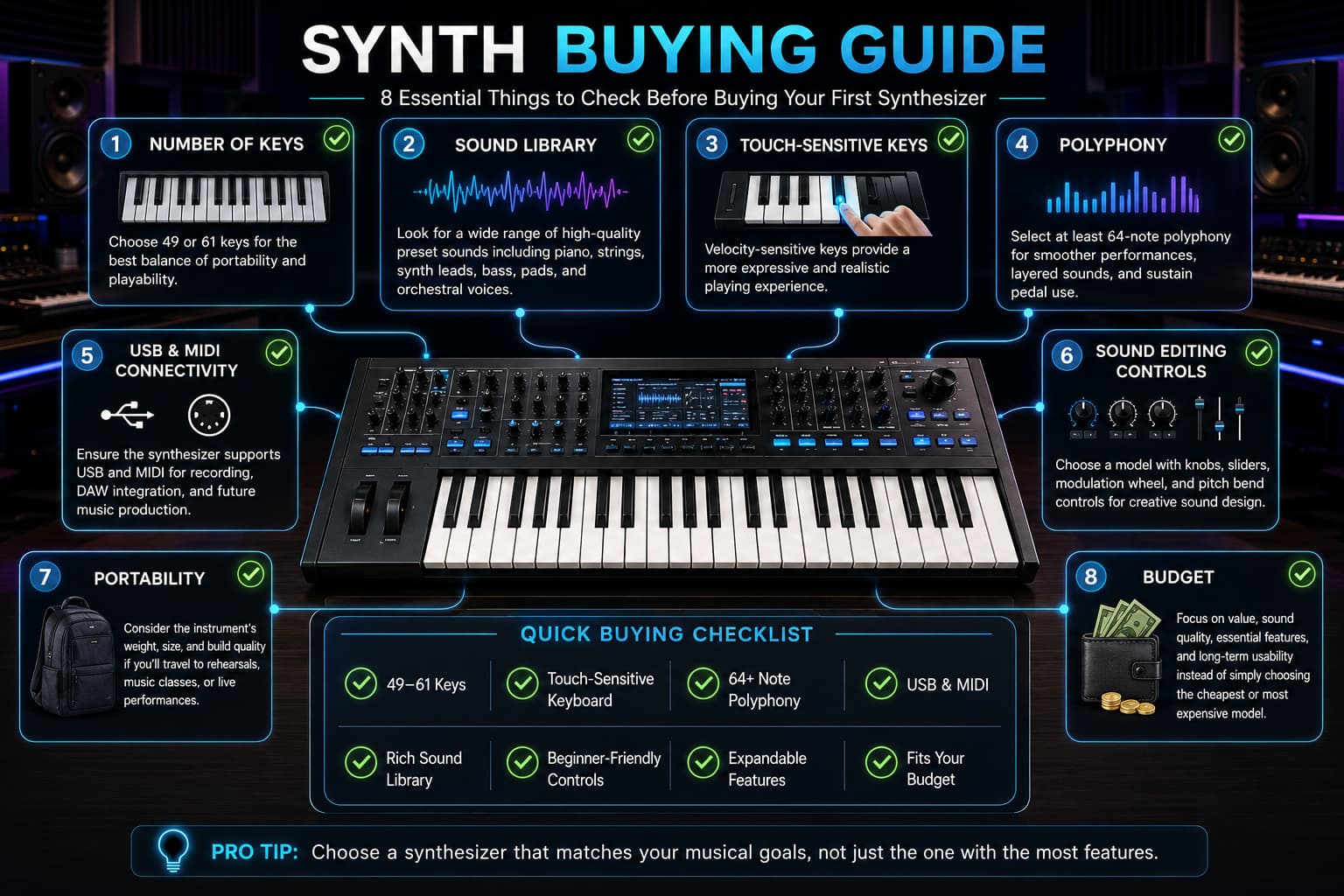
Getting a first synthesizers can be an exciting experience; however, there are a lot of varieties and functions that one can get lost in. Here are some useful guidelines to help you choose a synthesizers wisely.
1. Define Your Purpose
First, ask yourself why you need a synth. Are you studying music, writing songs, playing live, or composing? Your purpose will help you limit the proper selections.
2. Choose the Right Number of Keys
The number of keys in synthesizers should be selected according to the player’s style and space available. A 49 or 61-key synthesizer would serve as an excellent option for most beginners, providing a good compromise between both portability and usability.
3. Prioritise Sound Quality Over Quantity
Don't be fooled by the thousands of tunes pre-loaded. Choose a synth that can deliver high-quality, realistic sounds and is versatile enough to allow you to explore genres.
4. Look for Beginner-Friendly Features
Choose a synth with an easy-to-use interface, touch-sensitive keys, built-in learning features, and a clear display. These features make learning more fun and easier.
5. Check USB & MIDI Connectivity
In case you would like to use this equipment in the future for recording music or hooking up your synthesizer with a PC, make sure that it can work with both USB and MIDI.
6. Think About Future Growth
Get a synth that will grow with you. Also try and get a model with good editing controls, recording features and a good preset library; it will come in handy when you become more experienced.
7. Consider Portability
If you intend to take your synth to music classes, rehearsals or concerts, opt for a lightweight model that is easy to transport but still has all the features you need.
8. Don't Forget Essential Accessories
Finish your setup with accessories, including a keyboard stand, a sustain pedal, headphones and a gig bag. They make practice easier, increase comfort and protect your instrument.
9. Read Reviews and Try Before You Buy
Before you buy, watch demo videos, read customer reviews and if possible visit a music store to get a feel for the sound and touch of the synthesizers.
10. Buy from a Trusted Music Store
Apart from selling genuine products, an ideal music shop will offer you good advice, warranties, and even after-sales services. Your experience when purchasing your first synthesizer might be overwhelming; however, if you get the right advice, everything will be different.
Pro Tip: The best synth isn’t the one with the most features, it’s the one that fits your musical goals, your budget and inspires you to keep making music.
Conclusion
At this point, you definitely know what a synthesizers is and why it became such a popular instrument in today’s music industry.
No matter if you start playing your first instrument, compose music or play on stage, there are unlimited opportunities for you with a synthesizers. Getting familiar with the keyboard vs synthesizers comparison, discovering different synthesizers types and learning about the important features will enable you to buy an instrument without any hesitation.
The best synthesizers is not always the most expensive one but the one which will correspond to your needs and musical objectives.
Do some research and buy yourself an instrument that you will like using during many years.